

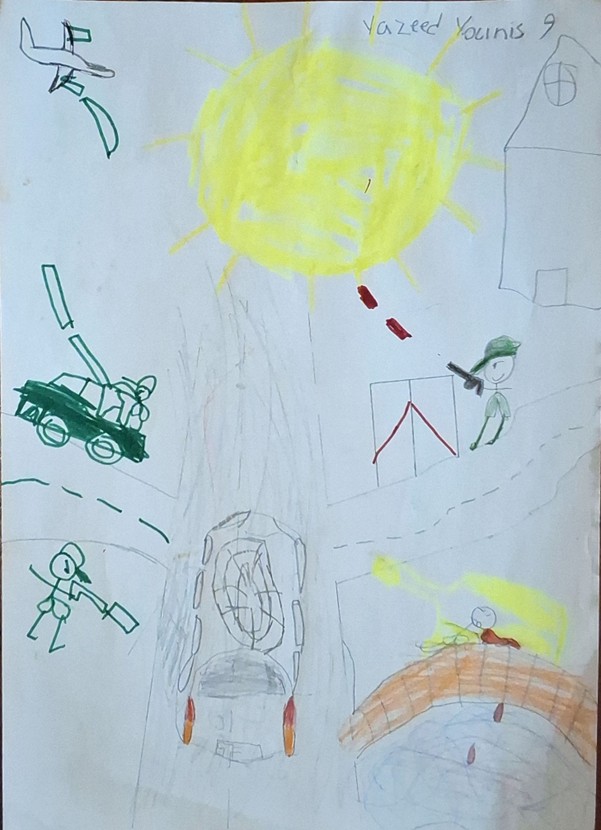
This is the story of a Sudanese mother of three who survived violence during the ongoing conflict. Her story reflects the harsh realities many families face as they flee war in Sudan in search of safety
Incident in Khartoum State
On 23 March 2025, early in the morning, my husband left for the market as usual. I stayed at home with my children. Later that morning, at around 10:00 a.m., a drone struck our house. By God’s grace, all of us survived without any physical injuries. When my husband heard the explosion in the area, he rushed back home. After seeing the damage, he immediately took us to his relatives’ house for safety.
A few days later, as the situation became more dangerous, my husband told me that he wanted to take us to South Sudan. He said he would take us to refugee camps and then return to Sudan to continue his small business so he could keep supporting us. He hired a lorry for us.
When we reached Bara in North Kordofan, the vehicle developed a mechanical problem. We stayed there for three days while the driver repaired the lorry. After it was fixed, we continued our journey.
As we were leaving Bara, we came across a checkpoint controlled by the Rapid Support Forces. They stopped the vehicle and ordered all of us to get out, including the driver. My husband, the driver, and my two sons were taken to one side, while me and my daughter were taken to the other side.
One of the soldiers came to me, grabbed my hand, and pulled me aside. He said they wanted to ask me some questions before allowing us to continue our journey. I did not understand what was happening.
My husband immediately came and held me back from the soldier, saying that if they wanted to question me, they should do it there and not take me away. The soldier threatened him, saying, “Do you want to die?” My husband answered, “You will not take my wife in front of me.”
At that moment, one of the soldiers shot my husband in the head. He fell to the ground and died in front of me and my children. We started screaming, crying, and calling for help.
They then took me into a nearby forest and assaulted me. They threatened me, saying that if I made any noise, I would follow my husband to the grave. I was helpless.
After about an hour, they brought me back to my children and to my husband’s body lying on the ground. They told me that my husband was a soldier in the Sudan Armed Forces and that this was why they killed him. But this was not true. He was not a soldier. He was only trying to protect me and our children.
After that, they left us under a tree with the driver we had hired.
Hours later, a truck carrying firewood on its way to Bara arrived. The men inside the truck were also wearing Rapid Support Forces uniforms. One of them asked why we were there with a dead body and what had happened.
I told him everything and asked for help to bury my husband. They then took us to a nearby village along the road toward Qantour. The people there helped us bury him.
That night, we were still inside the lorry when an elderly woman came to me and asked us to go and spend the night in her home. I went with my daughter, but my sons, Mazen and Mohammed, refused. They said they wanted to stay inside the vehicle.
The next morning, I went to check on them. I found my son Mohammed in severe pain. He was bleeding, crying, and could not move. I asked my younger son what had happened. My whole body was shaking, and the driver was not there.
My son told me that during the night, while they were sleeping, unknown men came, assaulted them, and took the driver away. He said when he tried to call for help, they kicked him and silenced him.
I rushed him to a small hospital in the village, but they told me they had no medicine to treat him and that I needed to go to El-Daein Hospital.
Later that day, we traveled to El-Daein in East Darfur State. My son received some treatment there. I was also examined and told I had medical complications, and I received treatment as well.
We had nowhere to stay and did not know anyone. Later, I met a young woman named Aziza, who took us into her home. We stayed with her for some time.
In November 2025, I crossed into South Sudan with my children. We arrived at Wedwill Camp on 20 November 2025, hoping for safety and care.
At the camp clinic, I explained everything that had happened to me and my son. We were given only basic medication, with no further treatment or referral.
Even now, my son Mohammed is still suffering. When the weather is cold, he feels pain and swelling. I can see it in his face before he even speaks.
My children are not the same anymore.
We are surviving, yes. But we are also carrying wounds that do not always show on the outside.
And still, we are trying to continue life.
Human Rights Context, Impact, and Recommendations
This case reflects serious violations of international humanitarian and human rights law, including attacks on civilians, sexual violence in conflict, and failures in the protection of women and children during displacement.
As the United Nations states:
“Civilians, including women and children, must be protected from all forms of violence during armed conflict.”
The Office of the United Nations High Commissioner for Human Rights warns that:
“Violations against civilians in conflict settings cause long-term trauma and lasting harm to communities.”
The UN Women further notes that gender-based violence in conflict situations has severe and lasting psychological and social impacts on survivors and their families.
The survivor and her children continue to experience deep trauma, including fear, emotional distress, and ongoing physical complications. Limited access to medical and psychosocial support, particularly after displacement, has further affected their recovery.
Comments are closed