

A Child’s Memory of Home: Sara’s Drawing Shows the Human Cost of the War in Sudan
War is often measured by the number of lives lost, the cities destroyed, and the people displaced. But behind these numbers are millions of children whose childhoods have been shaped by violence. The Sudan war impact on children is a particularly heartbreaking example of this tragedy.
For children, war means losing much more than a home. It means losing friends, schools, routines, and the simple moments that make childhood special.
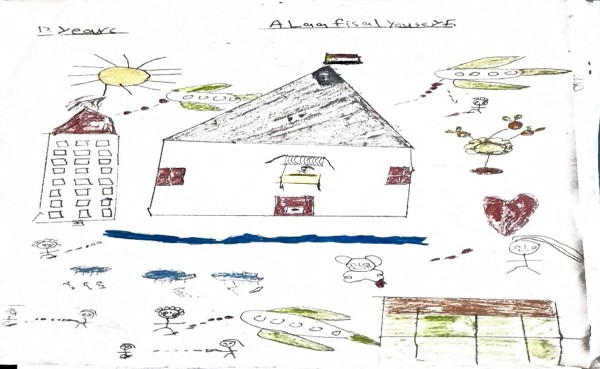
Sara, a 13-year-old Sudanese refugee participating in Trauma Rescue Aid’s (TRAID) art therapy program in Uganda, shared one of those stories through a drawing of her former school in Arkawit, Khartoum. Her drawing is not simply a picture of a building. It is a memory of a life that was taken away by war.
I Wish We Could Go Back
Sara carefully drew her school with its classrooms, the Sudanese flag, trees, and the bright sun above. She remembered every detail. When she explained her drawing, she spoke quietly about the people she missed most.
This is our school in Arkawit. I used to go there. My friends Samira and Hawa were very close to me. We used to play together during break time and do our homework together. I miss them. I do not know where they are now. School felt nice when we were all there together. I wish, maybe one day, we can go back to our school again.
When War Takes Away Childhood
The conflict in Sudan has forced millions of people to flee their homes. Children have been among the most impacted. Many have lost parents and witnessed violence. Others continue to live in refugee and internally displaced persons (IDP) camps with limited access to education, healthcare, and psychosocial support. The effects of war on children are not only physical. They are emotional, psychological, and long-lasting. Children like Sara carry memories that many adults would struggle to bear.
International Law Protects Every Child
The suffering of children during armed conflict is not only a humanitarian concern—it is also a matter of international law.
The United Nations Convention on the Rights of the Child (CRC) recognizes that every child has the right to education, protection from violence, and the highest attainable standard of physical and mental health. These rights apply to all children, including those affected by armed conflict.
Article 28 of the CRC recognizes every child’s right to education.
Article 29 states that education should help children develop their talents, abilities, dignity, and respect for human rights.
Article 39 requires States to promote the physical and psychological recovery and social reintegration of children who have experienced armed conflict, abuse, neglect, or violence.
The war in Sudan has made it impossible for many children to fully enjoy these rights.
Children Must Be Protected During Armed Conflict
International Humanitarian Law also provides special protection for children during war.
Under the Fourth Geneva Convention (1949) and Additional Protocol I, children are entitled to special respect and protection during armed conflict. Parties to the conflict must distinguish between civilians and military targets and take all feasible precautions to protect civilians, including children.
Schools, hospitals, and other civilian objects must not be attacked unless they become lawful military objectives under international humanitarian law. Even then, parties to the conflict must respect the principles of distinction, proportionality, and precaution to minimize harm to civilians.
The Safe Schools Declaration, endorsed by many countries, calls on governments to protect students, teachers, and schools during armed conflict and to ensure that education continues even during emergencies.
The Invisible Wounds of War
Many children who survive conflict continue to experience trauma long after they reach safety.
Without appropriate mental health and psychosocial support, these emotional wounds can affect children’s development for years. Healing requires more than food assistance and shelter.
Healing Through Art
At Trauma Rescue Aid (TRAID), art therapy helps children express emotions that are often too difficult to put into words.
Every week, 114 Sudanese refugee children participate in our art therapy and psychosocial support sessions in Uganda.
Some draw the homes they left behind. Others draw parents they miss. Some draw peaceful futures they hope to see. Sara chose to draw her school. Her drawing reminds us that children remember the places where they felt safe. Art gives children the opportunity to tell their stories, process painful memories, and begin healing in a supportive environment.
A Call to Action
The international community must not allow an entire generation of Sudanese children to lose their future.
Governments, humanitarian organizations, donors, and all parties to the conflict have a shared responsibility under international human rights law and international humanitarian law to protect children and ensure that their rights are respected.
We call for:
- An immediate end to attacks on civilians and civilian infrastructure, including schools.
- Respect for the Geneva Conventions, the Convention on the Rights of the Child, and other international legal obligations protecting children during armed conflict.
- Safe and uninterrupted access to education for all Sudanese children.
- Increased funding for child protection, education, and mental health services for displaced children.
- Accountability for serious violations against children, including attacks on schools and other grave violations documented under international law.
- Greater international support for humanitarian organizations providing lifesaving assistance and psychosocial care to refugee and displaced children.
Sara’s drawing reminds us that behind every statistic is a child who remembers a classroom, a friend, and a dream.
Protecting children is not only an act of compassion—it is a legal obligation under international law and a moral responsibility shared by the entire international community.
Comments are closed