

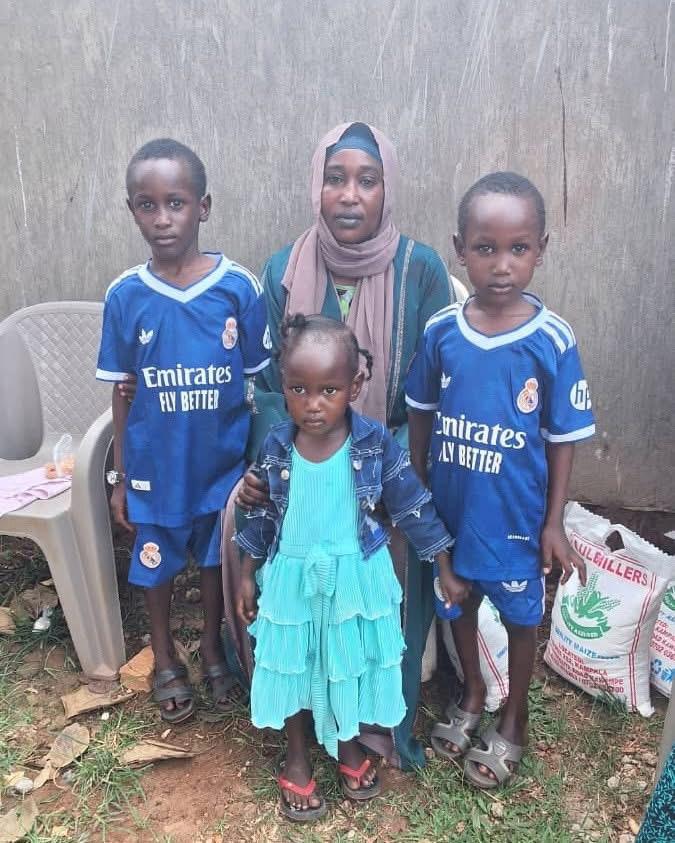
We left him behind in Sudan. No communication. I hope he is fine. This is part of an Al-Fasher survivor story.
For 37-year-old Sarah Ali, escaping the war in Al-Fasher, North Darfur, meant leaving behind almost everything that had once made her life feel secure. She lost her home, her livelihood and the teaching profession she loved. Most painfully, she became separated from her husband and was forced to continue the journey with their five children without knowing what would happen to him.
Before the war, Sarah’s life looked very different. For seven years, she worked as a primary school teacher, spending her days helping children learn and preparing them for their futures. Teaching was more than a job. It gave her independence, confidence and a sense that she was contributing to her community.
“Before the war, I worked as a teacher in Sudan for seven years. I loved my profession and the sense of purpose it gave me.”
Her husband was a businessman. Together, they worked, cared for their children and built their family life in Al-Fasher. Sarah remembers those days with sadness because almost everything that once felt normal has disappeared.
“My husband was a businessman, and I was a primary school teacher. Before the war, we were living together happily as a family. Everything we had before the war is now gone.”
War did not only take Sarah away from a physical place. It dismantled the life she and her husband had spent years building. A woman who once woke up thinking about her classroom and students suddenly had to think about survival: where to take her children, how to protect them, where they would sleep, what they would eat and whether they would live through the journey ahead. The most painful decision was continuing without her husband.
“When the war started, we got separated from my husband, and now I’m stranded raising the five children alone.”
Sarah fled with all five children while her husband remained behind. In the chaos of war, communication between them was lost.
“We left him behind in Sudan. No communication. I hope he is fine.”
Those words reveal one of the deepest wounds Sarah continues to carry. At times, she imagines that he is safe somewhere, perhaps also wondering what happened to his wife and children. At other times, fear takes over because she remembers what she witnessed while escaping.
“I’m terrified every night, struggling with fear and uncertainty about whether my husband is OK.”
Family separation during war creates a form of suffering that can continue long after a person has escaped immediate violence. Not knowing the fate of a loved one can leave families without answers and without closure. This is one reason International Humanitarian Law contains obligations relating to people reported missing during armed conflict and recognizes the importance of families receiving information about the fate of their relatives. For Sarah, however, this is not simply a question of international law. It is about her husband and the father of her five children.
Fleeing Al-Fasher with five children placed an extraordinary responsibility on Sarah. She was frightened herself, but there was little room to concentrate on her own fear. Five children were looking to her for protection.
She had to keep them together while moving through uncertainty. She had to think about whether the road ahead was safe, whether they would find food and shelter, and whether all five children would survive the journey.
What Sarah witnessed while escaping remains among her most painful memories.
“People were dying and no one was there to bury them.”
For Sarah, these were not photographs in a newspaper or figures in a humanitarian report. She saw people dying while she was trying to keep her own children alive. The experience demonstrates the human reality behind the principles of International Humanitarian Law. IHL exists because even war has limits. Civilians are not legitimate targets simply because fighting is taking place around them. Parties to armed conflict are required to distinguish between civilians and combatants and between civilian objects and military objectives. Civilians must be protected against direct attack unless, and for such time as, they directly participate in hostilities. Indiscriminate attacks are prohibited, and applicable precautions must be taken to reduce civilian harm.
Common Article 3 of the Geneva Conventions captures one of the most fundamental principles: people who are not, or are no longer, taking active part in hostilities “shall in all circumstances be treated humanely.”
For a mother like Sarah, those words have a very practical meaning. Civilian protection is about whether a mother can move her children away from danger without being attacked. It is about whether families can find food, water and medical assistance. It is about whether women and children are protected from violence. And it is about preserving human dignity even when conflict has destroyed almost everything else.
“Sometimes I have nightmares from the things that I saw when we were escaping from the war.”
When she lies down and tries to sleep, memories of the journey return.
“Every night when I go to bed, all the memories of the dead people and the sounds of guns keep replaying in my dreams.”
Sleep should offer relief from the pressures of the day. For Sarah, it has become another source of fear. When she closes her eyes, the physical distance between her present circumstances and the violence she escaped can seem to disappear. The images and sounds return through her dreams, making it difficult for her to rest.
“Sometimes I feel like I am sick because I cannot sleep.”
Eventually, Sarah began to fear the arrival of nighttime itself.
“When night comes, I get scared all the time. I wish there was no night.”
Her words communicate the psychological consequences of war more powerfully than a clinical label could. Sarah should not be diagnosed through her testimony alone. But her nightmares, recurring memories, fear and inability to sleep demonstrate serious emotional distress that deserves recognition and appropriate support. Her suffering is also intensified by the uncertainty surrounding her husband. At night, Sarah is not only remembering what she witnessed. She is also wondering what may have happened to the person she left behind.
Night after night, she remembers the sounds of guns and the people she saw while simultaneously wondering whether her husband may have faced the same violence.
“I’m struggling to feed the kids.”
Before the war, she was employed as a teacher and her husband was a businessman. They shared responsibility for supporting their household. Today, Sarah is trying to carry responsibilities that once belonged to two parents while the economic foundations of their family have been destroyed.
This is one of the ways war can place an enormous burden on women. A woman may become displaced herself while simultaneously becoming the sole caregiver and provider for her children. She may be dealing with grief, fear or painful memories while having almost no opportunity to concentrate on her own wellbeing because children depend on her.
Sarah’s experience is personal, and it should not be assumed that every Sudanese woman experiences war in the same way. But her story sits within a much wider crisis affecting women and girls across Sudan.
Women have experienced forced displacement, family separation, loss of livelihoods, hunger, disrupted healthcare and serious protection risks. Women and girls have also faced documented risks of conflict-related sexual and gender-based violence.
The consequences of such violence can continue long after the immediate incident. Survivors may experience physical injuries as well as fear, stigma, isolation and psychological distress. Women who have not personally experienced sexual violence may nevertheless live with persistent fear for themselves, their daughters and other female relatives.
International Humanitarian Law recognises that women have the same general protections as other civilians while also requiring attention to specific protection, health and assistance needs arising during armed conflict. Rape and other forms of sexual violence are prohibited under IHL.
These protections matter because war can affect women in multiple ways at once. A woman can be displaced, separated from her husband, responsible for children, deprived of her livelihood and living with fear, all at the same time.
And she remains a woman who wants the opportunity to regain control over her life.
This is why support for women affected by Sudan’s war must go beyond emergency survival. Food, shelter, healthcare and physical protection are essential, but survivors may also need mental-health and psychosocial support, family tracing, education for their children, legal assistance, livelihood opportunities and safe communities in which they can begin rebuilding their lives.
She escaped Al-Fasher with her five children, but survival has brought another struggle: learning how to live with what she witnessed while carrying the responsibilities of the family she managed to bring to safety..
And somewhere between those painful memories and the responsibilities of the present, Sarah continues to hold onto hope.
“My greatest hope is to rebuild my life and create a better future for my children.”
Her story shows why civilian protection cannot be measured simply by whether someone survives an attack or manages to escape a battlefield. Genuine protection must also recognise what comes afterwards: the separated family, the sleepless nights, the children who need food, the livelihood that has disappeared, and the long journey towards recovering dignity, confidence and a sense of safety.
Comments are closed