

At Trauma Rescue Aid (TRAID), we meet children who have lived through experiences most adults struggle to imagine. Conflict, displacement, sudden separation from friends and routines. Many arrive without the words to explain what they feel. This is where child art therapy for war-affected children can gently open the door to healing, offering an approach rooted in art therapy tailored for their needs.
This is Fayha’a, a 14-year-old girl from Khartoum, she quietly in one of our sessions and began to draw. There were no signs of war in her artwork. No explosions. No destruction. In fact, her participation is a testament to how war-affected children benefit from child art therapy during times of trauma and instability. In these situations, child art therapy for war-affected children uniquely addresses emotional needs.
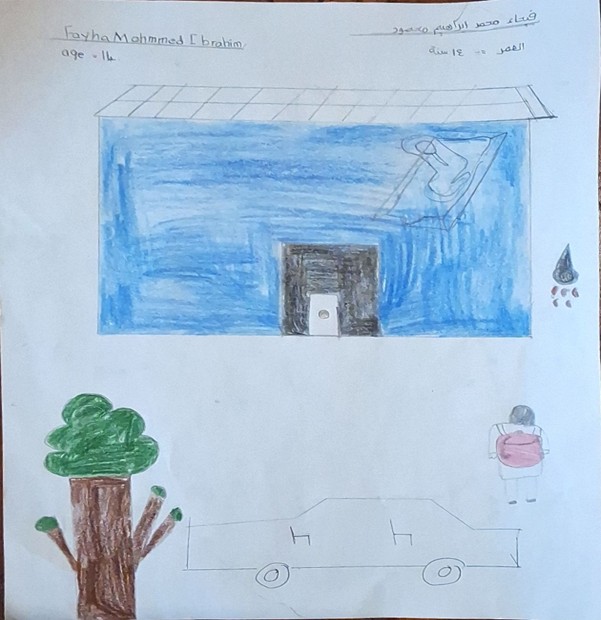
Instead, she drew her school.
El-Hakim International School, painted blue. Her favorite color, she said. You can almost see it bright, calm, the kind of place where life felt normal, where things made sense. Additionally, child art therapy for those children impacted by war can evoke memories of such comforting places.
Every morning, her father would drive her there, drop her at the gate, and head to work. She would walk into the school compound, just like any other student, starting their day. The process of child art therapy for war-affected children can help them reconnect with familiar routines in their drawings.
And then there’s Khadija.
Her best friend. The one she use to do assignment with, and shared stories with. Those small, ordinary moments that don’t feel like much at the time, but somehow become everything later. For war-affected children, art therapy provides a way to process friendship and loss.
For a child of her age, this kind of uncertainty is not just difficult. It is deeply disorienting. At 14, a child’s world is still forming, shaped by friendships, school routines, family connections, and a sense of belonging. Using child art therapy, war-affected children can make sense of disruptions in their world where words are insufficient.
Today, Fayha’a is living in a refugee camp in Uganda. Her school, her daily routine, and her social circle are no longer part of her present reality. What remains is memory, and through her drawing, she expresses a connection to a life that existed before displacement. In this context, art therapy for children affected by war supports maintaining their sense of self. Importantly, child art therapy for war-affected children in such environments helps maintain hope and continuity amid uncertainty.
Why art therapy matters in humanitarian response
Our psychosocial support teams use structured art therapy sessions as part of our daily programming with children affected by war and displacement. These sessions are not simply about drawing or creativity. They are carefully facilitated safe spaces designed to support emotional expression, reduce distress, and encourage gradual healing. In particular, child art therapy for children who have experienced war and trauma offers a bridge to emotional recovery.
Children are often invited to draw places, people, or moments that are meaningful to them. This approach allows them to communicate experiences that may be too painful to express verbally. Through colors, shapes, and symbols, children begin to express their inner world in a way that feels safe and non-disturbing. For war-affected children, child art therapy is crucial in enabling them to safely share feelings.
In Fayha’a’s case, her drawing reflects memory, attachment, and a quiet sense of longing. But it also reflects something equally important, highlighting the possible outcomes when child art therapy is used with war-affected children.
Resilience.
The ability to remember, to create, and to share a personal story is often one of the first steps toward emotional recovery. It helps children reconnect with their identity, even when their external world has changed dramatically.. Through child art therapy, war-affected children frequently rediscover strength and creativity.
Our social workers observe, listen, and engage with each child’s drawing without judgment. They create a safe environment where children feel seen, heard, and respected. Over time, children often become more open, more expressive, and more comfortable sharing their stories and emotions. Ultimately, providing art therapy specifically for children affected by war is vital for resilience and hope. Furthermore, child art therapy for war-affected children builds pathways for long-term mental wellbeing.
Why this story matters
Stories like Fayha’a’s are not just individual stories. They reflect a much larger reality affecting countless children across conflict-affected communities in Sudan. This reality underscores the necessity of child art therapy as a healing intervention for war-affected children.
Behind every drawing, there is a stories. A classroom once attended daily. A friend once sat beside. A parent once relied on for comfort. By encouraging art therapy, we empower war-affected children to articulate these transformative memories.
These are not small details. They are the building blocks of a child’s world. Child art therapy provided for war-affected children serves to reinforce these building blocks.
Sharing Fayha’a’s story is part of our commitment to making sure children affected by conflict are not only seen as survivors of crisis, but as individuals with memories, relationships, and hopes for the future. Through child art therapy, even war-affected children can reclaim their narratives.
Their voices matter. Even when those voices come through drawings instead of words. For many war-affected children, child art therapy provides a means for their voices to be heard.
A Closing Reflection
Fayha’a’s drawing is not just an image of a school. It is a reflection of a life interrupted, a memory preserved, and a quiet expression of continuity in the face of uncertainty. It is important to note that for war-affected children, child art therapy has the power to reveal hope within hardship. In summary, child art therapy for war-affected children plays a vital role in fostering hope and recovery.
She still remembers her school.
She still remembers her friend.
And she still holds onto the hope of seeing her again one day. Through child art therapy, war-affected children often hold on to hope of reconnection.
In many ways, that hope is where healing begins.
Fayha’a still hopes to see Khadija again one day. Child art therapy provides war-affected children with a way to preserve such hope for the future.
2 Responses
The article is good and nicely formatted. The site
is useful and efficient.
Really well thought-out and clearly presented.
The entire site deserves praise.